
Table of contents
- Choose dog training treats for the lesson ahead
- Soft bites keep dog training treats manageable
- Read puppy and dietary suitability before buying
- Give dog training treats a daily allowance
- Make the reward arrive at the right moment
- Keep favourite rewards for the right job
The most useful dog training treats are small, easy to eat, and genuinely rewarding to your dog. Start with your dog’s normal food for easy practice before buying anything extra. When you do need something more appealing, choose small, soft rewards, and save your dog’s absolute favourites for new skills or distracting places. You don’t need the priciest bag on the shelf to get results (see the AKC food reward guidance).
Choose dog training treats for the lesson ahead
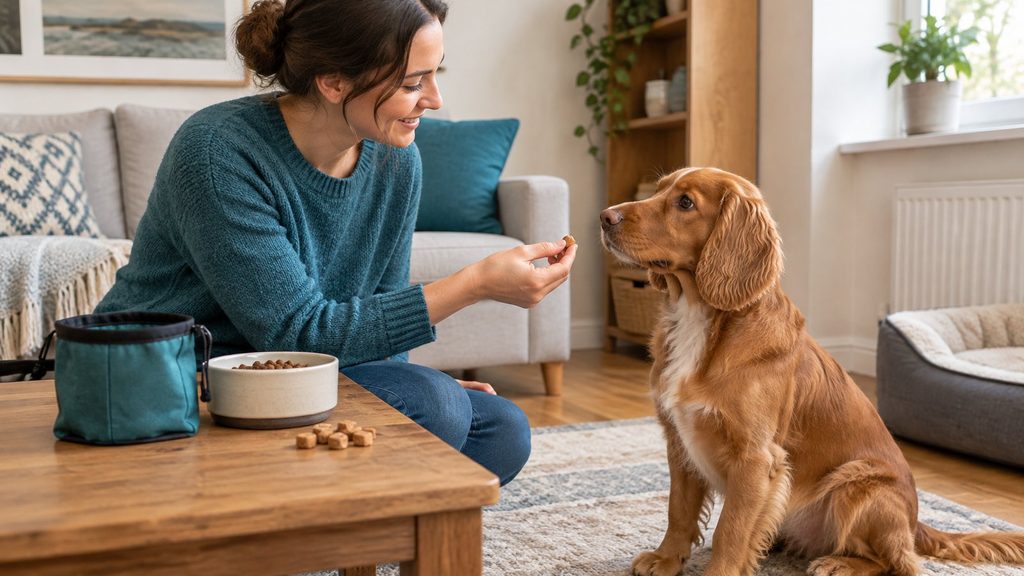
Your dog’s enthusiasm matters far more than the word “training” printed on a packet. The American Kennel Club advises figuring out what your individual dog actually enjoys and matching that to how hard the exercise is. Practising a sit in a quiet kitchen needs a very different reward from working around distractions down at the park. Try suitable foods in small amounts before you stock up on large bags.
To keep things cost-effective, follow this order:
- Usual food first: Try a portion of your dog’s normal complete food as your starting point. Only buy extra treats if that standard kibble isn’t holding their attention.
- Soft meat-based bites: For new skills or busier environments around Dalry and the Garnock Valley, grab a small pack of soft bites your dog loves.
- Rapid repetitions: Choose pieces you can easily break up and deliver quickly without a long chewing delay.
This matches the reward hierarchy outlined in Battersea’s training motivation guide and the Ontario SPCA’s tips on small training rewards. Treat them as flexible starting points rather than rigid rules. Before you shop, write down what you actually want to achieve—like “rewarding eye contact in the garden”—rather than just heading out to buy better treats.
Soft bites keep dog training treats manageable
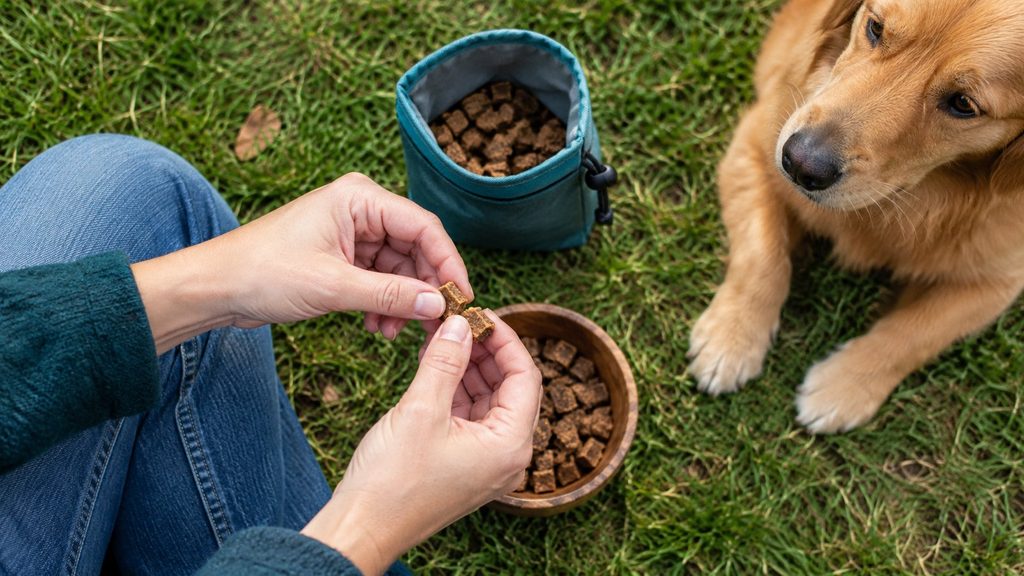
For repeated practice, soft or moist pieces work best because they are quick to chew. The Ontario SPCA points out that large rewards interrupt training momentum while the dog finishes eating. A crunchy biscuit can still have its uses, but always match the texture to the pace of the exercise.
Before buying a new bag, follow these steps:
- Step 1: Check if you can cleanly break a single piece into smaller bits.
- Step 2: Make sure you can grab them easily out of your pouch on the move.
- Step 3: Ensure your dog can finish them comfortably before the next repetition starts.
Supervise your dog and avoid giving overly hard chews during fast-paced training. Long-lasting chews have a totally different purpose than quick training rewards; check the WSAVA treat feeding guide for sizing advice and what to avoid.
Read puppy and dietary suitability before buying
If you’re looking at puppy training treats, check the age guidance on the pack alongside the ingredients and feeding instructions. Don’t assume a product is suitable just because the pieces are tiny. If your dog has a sensitive stomach, a medical condition, or a vet-prescribed diet, check with your vet team before adding standard treats.
Always check the ingredients list rather than relying on front-of-pack marketing claims. Keep the packaging handy so you can check the actual recipe. Plain cooked chicken is often a brilliant, cheap alternative to specialist training products. The PDSA recommends steam-cooked chicken among their treating options. Whether you use shop-bought bites or food from home, portion it out before you start training instead of topping up your pouch on the fly (see PDSA’s healthy treating advice).
Give dog training treats a daily allowance
Count all extras across the whole day, including daily chews and any food used for medication. WSAVA advises keeping treats below 10% of your dog’s daily calories and getting a proper energy requirement from your vet. That’s a maximum ceiling, not a target—their regular balanced food comes first.
Follow these steps to manage daily portions:
- Step 1: Set aside a portion of your dog’s normal daily food allowance specifically for training.
- Step 2: Put that day’s total reward supply into one container or pouch.
- Step 3: Make sure everyone in your household uses that same supply so people aren’t accidentally adding extra handfuls all day.
When comparing products, look at how many usable pieces you get for your money, not just the sticker price. A divisible treat might give you dozens of tiny rewards, whereas a bigger piece gets eaten all at once. Note that more pieces don’t mean fewer calories overall.
For example, comparing two options: a £3.00 bag with 60 treats that break into 3 pieces gives 180 rewards (approx. £0.017 each), while a £2.50 bag with 100 ready-made pieces works out at £0.025 each. The first option costs more upfront but gives you more rewards per penny, though you still need to watch the overall calorie intake.
Make the reward arrive at the right moment
Get your training treats ready before you start so you can reward the exact moment the behaviour happens. The PDSA highlights the importance of prompt timing, short sessions, and focusing on one cue at a time. For instance, reward a sit while your dog is actually sitting, rather than waiting until they’ve stood back up to check your pockets (see PDSA’s reward-based training advice).
Try this simple handling rehearsal without your dog first:
- Step 1: Reach into your pouch and take out a single treat piece.
- Step 2: Move your hand cleanly to your reward delivery position.
- Step 3: Reset and repeat until your timing feels smooth and natural.
If you’d like hands-on coaching around Dalry, Beith, Kilbirnie, or the Garnock Valley, Mikes Mutts offers force-free, reward-based 1-to-1 sessions lasting around an hour. Find out more on our private training sessions page.
Keep favourite rewards for the right job
Battersea recommends keeping higher-value rewards for new behaviours or places with heavy distractions. Use calm food rewards for settled indoor exercises, and save high-value treats or toys for outdoor recall. Match the reward to what your dog actually needs in that moment.
Start with small quantities, manage your daily food portions, and save the best treats for when the job is tough. When you’re ready to build a solid training routine, get in touch or book your session through our booking and payment page.
Frequently asked questions
Must I keep giving dog training treats for every recall?
PDSA notes that as recall improves, you won’t need a food reward every single time. Phase them out gradually as reliability builds rather than cutting them off immediately.
Does high-value mean a treat costs more?
No. It just means how much your dog wants it. Battersea explains that strong-smelling foods often rank way higher than normal kibble without needing an expensive brand.
Can praise replace food if my dog prefers it?
Yes, some dogs respond brilliantly to praise or gentle physical attention. Battersea advises figuring out what your specific dog enjoys most rather than assuming food is always top of their list.